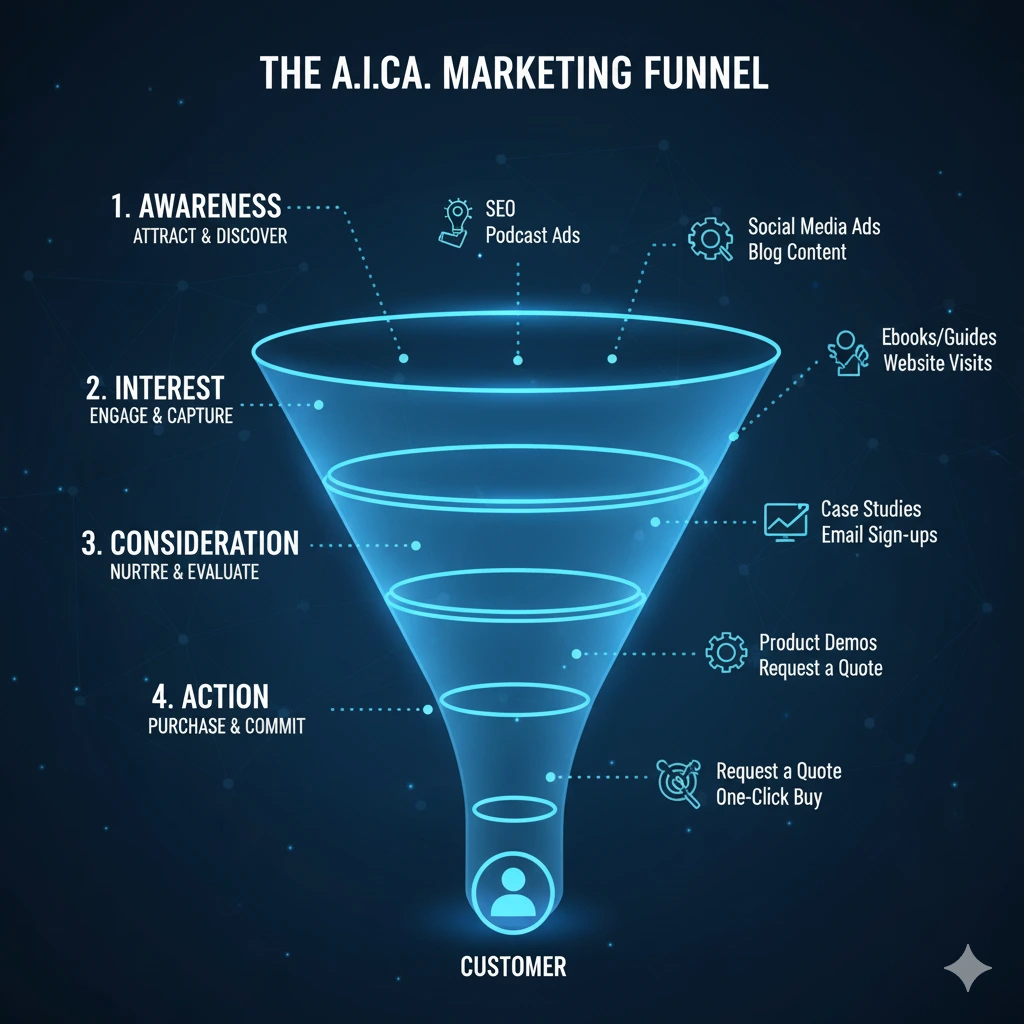
What Is the Digital Marketing Funnel?
An online variation of the traditional sales funnel is the digital marketing funnel. It lays out the processes that consumers go through, from learning about your brand to buying something (and hopefully becoming devoted supporters).
Four primary stages are commonly used to categorize the funnel:
1.Awareness (Top of Funnel – TOFU)
Here, individuals learn about your brand for the first time.
They can get to you through Google search, social media advertisement, blog posts, or word of mouth.
Example: An individual notices your Instagram post regarding environment-friendly shoes.
2.Interest (Middle of Funnel – MOFU)
Now, the consumer is interested in knowing more about your brand.
They visit your site, read your blog, or view a product video.
Example: They click on your blog “Why Sustainable Shoes Are Better for the Planet.”
3.Consideration (Bottom of Funnel – BOFU)
The customer is seriously considering whether to purchase from you or a competing company.
They look at reviews, view testimonials, or compare prices.
Example: They opt-in to your newsletter in order to receive a discount code.
4.Action (Conversion)
The customer makes the purchase decision.
Example: They proceed with the purchase and order your environmentally friendly shoes.
???? Some digital marketers also add an extension of the funnel with a retention phase, where they concentrate on developing long-term loyalty following the initial purchase.
Why Is the Digital Marketing Funnel Important?
A well-designed Digital Marketing funnel provides a number of advantages:
Improved segmentation: You’re able to serve up the proper content at the proper time. For instance, blog articles for awareness, case studies for consideration, and discounts for action.
Improved lead generation: Rather than pursuing unqualified leads, you’re working on prospects that are actually interested in your offer.
More efficient use of resources: Your marketing team clearly understands what content to produce for every step, with no waste of time and budget.
Overall, the Digital Marketing funnel keeps your efforts organized, strategic, and customer-centric.
How to Build a Digital Marketing Funnel for Your Business
1. Define Your Target Audience
- Before constructing anything, you need to know:
- Who do you sell to?
- What do they pain about, want, and achieve?
- Where do they hang out online?
2. Create a Lead Magnet
- Free eBook or checklist
- Discount code
- Free consultation
- Mini-course or webinar
Objective: Get potential customers from “interested” → “engaged”.
➡️ Example: “Download our Free Candle Scent Guide to find your perfect aroma.”
3. Create a Landing Page
- Tackle one clear offer
- Have a compelling headline
- Present benefits (not features)
- Contain testimonials or proof
- End with a clear call-to-action (CTA)
Tool recommendations:
No-code: Systeme.io, HubSpot, Wix, or Leadpages
Pro: WordPress + Elementor, Webflow
4. Install Email Marketing Automation
- Welcome email → get to know your brand
- Story email → tell your “why”
- Value email → teach or inspire
- Offer email → sell your product
5. Send Traffic to Your Funnel
- Use a combination of paid and organic traffic:
- SEO (Google search visibility)
- Social media (Instagram, TikTok, LinkedIn based on your audience)
- Paid ads (Google Ads, Meta Ads)
- Partnerships or influencer marketing
- Content marketing (blog posts, YouTube)
6. Optimize and Test
- Monitor performance with:
- Google Analytics (traffic & conversions)
- Meta Pixel (for retargeting)
- Email open/click rates
- A/B testing on headlines, CTAs, or images
➡️ Set your sights on optimizing:
Conversion Rate (visitors → leads)
Cost per Lead (CPL)
Return on Ad Spend (ROAS)
Example funnel (for a product business)
- Product: Handmade candles
- Ad: Instagram reel highlighting candle pouring → “Want your home to smell amazing naturally?”
- Landing Page: Give away a free Candle Scent Guide
- Email sequence: Tips + 10% discount code
- Checkout Page: Simple, trust badges, limited-time offer
Beyond the Sale: Retention & Loyalty
The funnel doesn’t end when a customer clicks “Buy.” Indeed, retaining customers after the purchase is one of the most lucrative moves.
Provide top-notch customer care.
Send thank-you messages and tips.
Build referral incentives or loyalty programs.
Keep them engaged by sending newsletters, social media, and updates.
Conclusion
The digital marketing funnel is not just a theory — it’s a working model for taking customers through awareness to purchase and beyond. By customizing your marketing to every step of the funnel, you’ll draw in the right audience, establish trust, boost conversions, and repeat business.
If you haven’t created a map of your funnel yet, it’s time to begin. Each click, each view, and each interaction can be a chance to convert strangers into repeat customers.